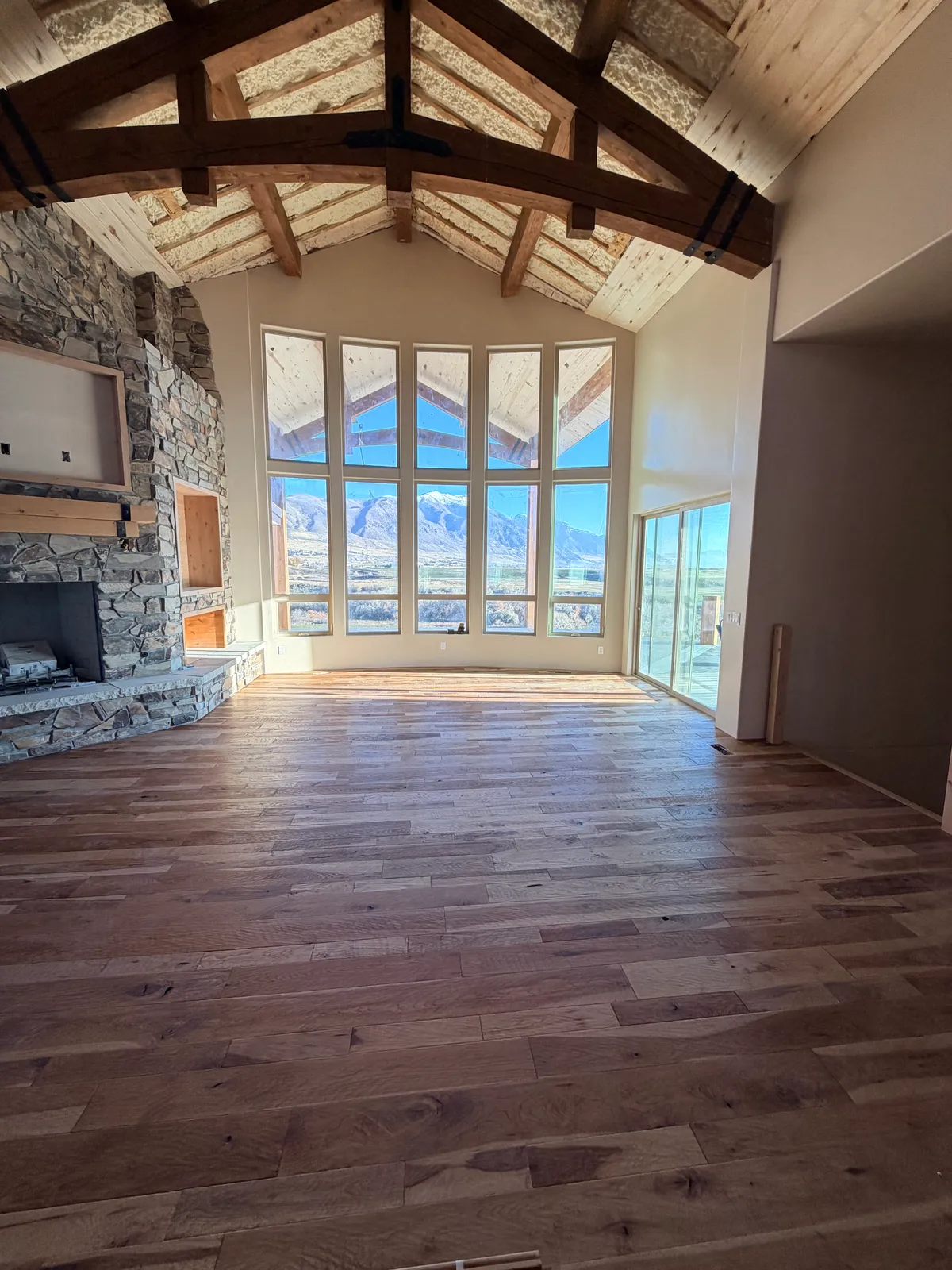
A floor that looks perfect in a showroom can gap, warp, or crack inside your actual home. In Utah, that happens more often than most people realize, and it almost always comes down to one thing: our climate.
Before you spend thousands on new flooring, you need to understand what makes Utah uniquely tough on floors. This guide breaks down the best and worst options for homes from Draper to Davis County and everywhere in between.
Table of Contents
- Why Utah Is Tough on Floors
- Engineered Hardwood: The Best All-Around Choice
- Waterproof Laminate and LVP: The Waterproof Options
- Solid Hardwood: Beautiful but Risky
- Room-by-Room Recommendations
- How to Protect Your Floors Through Dry Utah Winters
- The Smartest Way to Choose
Why Utah Is Tough on Floors
Most flooring advice online is written for the national average. Utah is not the national average.
Here is what your floors are dealing with:
- Indoor humidity drops to 10-20% in winter. Most flooring would prefer 35-55%.
- We live at elevation. Higher elevation means drier air year-round.
- Temperature swings are real. Floors expand and contract through the year.
- Summer moisture spikes still happen. That swing back and forth matters almost as much as the dryness itself.
Wood-based products absorb and release moisture. When the air is bone-dry, wood shrinks. When moisture comes back, wood swells. The wrong product will not handle that cycle gracefully.
Engineered Hardwood: The Best All-Around Choice
If I had to pick one flooring type for most rooms in a Utah home, engineered hardwood wins.
Engineered hardwood gives you a real wood top layer over a layered core that resists movement better than solid wood.
Why it works well in Utah:
- it handles humidity swings better than solid hardwood
- you still get real wood beauty and warmth
- it works in more install scenarios
- quality products can still be refinished depending on the wear layer
If you want the hardwood feel without taking on unnecessary climate risk, engineered hardwood is usually the best answer.
For the deeper comparison, read engineered vs. solid hardwood in Utah.
Waterproof Laminate and LVP: The Waterproof Options
This is where Utah flooring searches get messy. Many homeowners search for LVP flooring Utah when what they really want is a waterproof wood-look floor that can handle real life.
In practice, the right comparison is usually waterproof laminate vs. LVP, not just one acronym in isolation.
Waterproof laminate is often the better fit for Utah main floors when you want:
- a wood look that reads more furniture-friendly
- stronger feel underfoot
- better performance across big open-plan rooms
- good stability through Utah’s dry winters
LVP still makes sense when:
- true waterproof performance matters most
- the room has meaningful water exposure
- the project is basement-heavy or rental-oriented
For many Utah homeowners, waterproof laminate ends up being the better answer in living rooms, bedrooms, and connected main levels, while LVP stays strongest in more moisture-prone zones.
If you are starting from that search, read our Utah LVP guide and hardwood vs. LVP in Utah.
For a head-to-head comparison of laminate and hardwood, see our laminate vs. hardwood breakdown.
Solid Hardwood: Beautiful but Risky
Solid hardwood is gorgeous. There is a reason people love it.
But in Utah, solid hardwood is the highest-maintenance option and the most likely to create seasonal movement headaches.
Solid hardwood can work when:
- it is on a stable main level
- the home is climate-controlled consistently
- the owner is willing to manage humidity
Solid hardwood is a riskier call for:
- basements
- rooms over concrete
- radiant-heat situations
- homes where winter humidity drops and stays very low
If you love the look of real wood but want to be practical about Utah’s climate, engineered hardwood gives you most of the beauty with much less risk.
Room-by-Room Recommendations
Kitchen
Best choice: waterproof laminate or LVP
Kitchens see water spills, dropped pans, and heavy foot traffic. Waterproof laminate and LVP both handle that reality well. Engineered hardwood can work in open floor plans where you want the kitchen to match the living area, but you need to be faster about cleanup.
Read our full guide: best flooring for kitchens
Living Room / Great Room
Best choice: engineered hardwood or waterproof laminate
This is where real wood often pays off, especially in homes where resale matters. Waterproof laminate is the stronger practical alternative when the budget or lifestyle points that direction.
Bedrooms
Best choice: engineered hardwood or waterproof laminate
Bedrooms are lower-moisture spaces, so both work well. Budget and finish level should decide it.
Basement
Best choice: LVP or waterproof laminate
Utah basements deal with concrete subfloors and potential moisture from below. LVP and waterproof laminate are both strong here. Engineered hardwood can work in a well-controlled finished basement, but it is usually not the safer bet.
Full breakdown: best flooring for Utah basements
Bathrooms
Best choice: LVP or tile
Water is a given. Tile is still the traditional winner, with LVP as the more forgiving wood-look option. We do not recommend real wood in bathrooms. For a full ranking, see our best flooring for bathrooms guide.
Mudroom / Entryway
Best choice: LVP, waterproof laminate, or tile
Utah mudrooms deal with snow, salt, gravel, and wet boots from November through March. You want something waterproof and scratch-resistant.
How to Protect Your Floors Through Dry Utah Winters
Run a humidifier. The National Wood Flooring Association recommends maintaining 35-55% indoor humidity for hardwood floors. Keeping indoor humidity between 35-45% through winter protects your floors and woodwork.
Do not overheat the house. Forced-air heating is one of the biggest humidity killers in Utah homes.
Use rugs in high-traffic areas. They catch grit and reduce wear, especially in winter.
Clean smart. Use a damp mop, not a soaked floor.
Acclimate your flooring before installation. In Utah, this step matters.
The Smartest Way to Choose
See your flooring samples in your actual home before you decide.
A showroom has controlled lighting, controlled temperature, and controlled humidity. Your home has west-facing windows, dry winter air, and the way your family actually lives in the space.
That is exactly why we bring the showroom to you. We load up samples of what makes sense for your situation, show up at your house, and let you compare them in the real environment where the floor has to work.
For a full breakdown of what our flooring projects cost in the Salt Lake City area, check out our 2026 flooring cost guide.
Ready to Find the Right Floor for Your Utah Home?
We will bring curated samples to your door and help you choose the right material for every room. No showroom trip required.