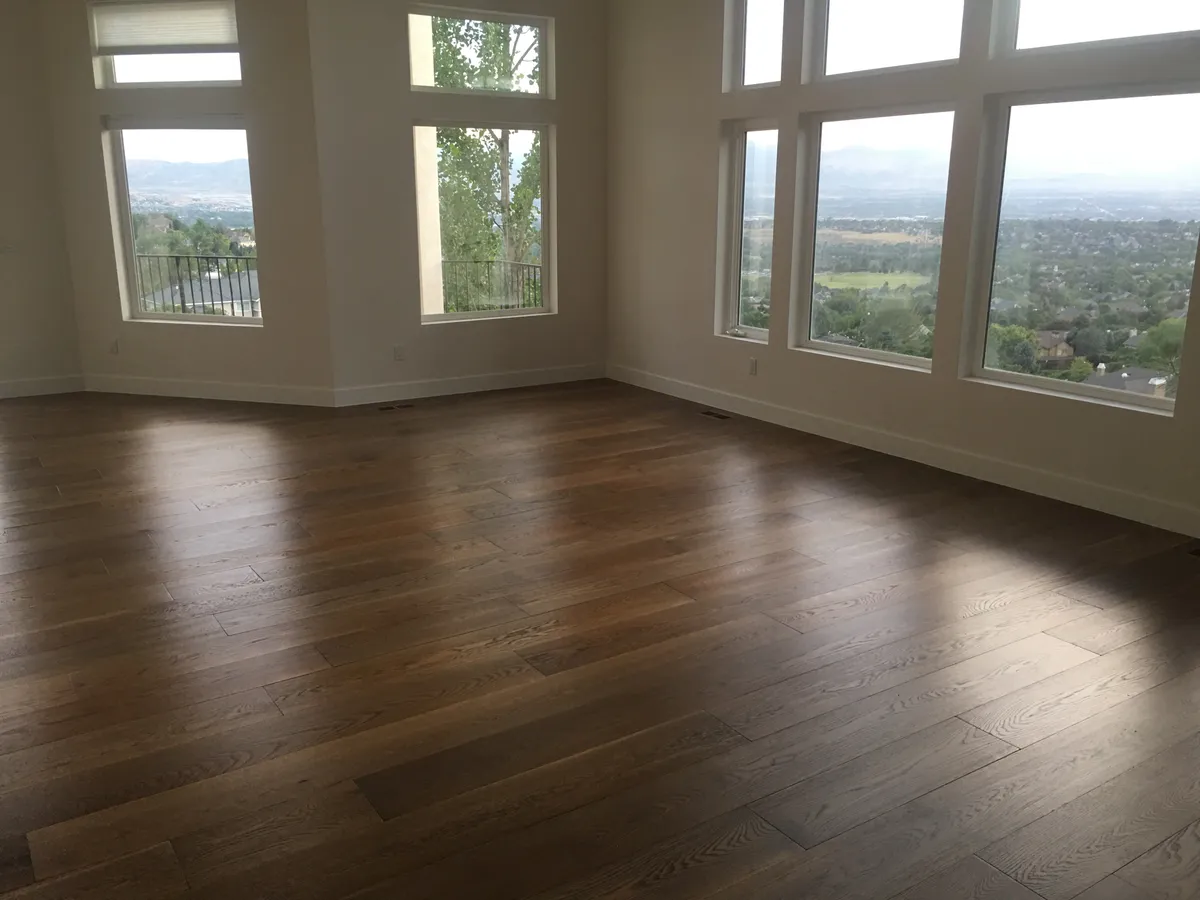
Engineered vs. Solid Hardwood: Which Is Right for Utah Homes?
If you have decided you want real hardwood floors, the next decision matters more than most homeowners realize: engineered or solid?
Most flooring advice treats this like a toss-up. “Both are great options” is not useful enough in Utah. Our dry air, winter heating, radiant heat, concrete subfloors, mountain homes, and basement-heavy layouts make engineered hardwood the smarter default for most homes.
Solid hardwood still has a place. It is just a narrower place than many homeowners expect.
Quick Answer: Engineered or Solid Hardwood in Utah?
For most Utah homes, engineered hardwood is the better starting point because it handles seasonal movement better, works in more installation situations, and still gives you real wood on the surface.
Solid hardwood makes sense when the home has stable main-level conditions, a nail-down subfloor, good humidity control, and the homeowner values long-term refinishing life enough to accept more seasonal movement.
The short version:
- Best default for Utah homes: engineered hardwood
- Best for dry winter air: engineered hardwood
- Best over concrete or radiant heat: engineered hardwood
- Best long-term refinish potential: solid hardwood
- Best for basements: neither; use a more moisture-tolerant floor
- Best for mountain homes: usually engineered hardwood in main spaces
The Core Difference (In Plain English)
Solid hardwood is exactly what it sounds like. One solid piece of wood, typically 3/4 inch thick. Oak, maple, walnut, hickory. Whatever species you pick, it’s that wood all the way through.
Engineered hardwood has a real wood top layer (called the wear layer) bonded to a base of cross-layered plywood or HDF. Think of it like plywood with a beautiful hardwood face. That cross-grain construction is the whole reason it exists. It resists movement that a solid plank can’t.
Both are real wood. Both feel like real wood underfoot. The difference is what’s underneath the surface, and that difference matters a lot in our climate.
How Utah’s Dry Air Affects Each Type
This is where the conversation gets real.
Wood is hygroscopic. It absorbs moisture from the air and releases it back. When the air is humid, wood swells. When the air is dry, wood shrinks. This is true for all wood products, but the degree of movement is dramatically different between solid and engineered.
Utah’s indoor humidity can drop hard in winter once the heat runs. Hardwood flooring generally performs best when indoor humidity is kept in a stable range, but many Utah homes spend long stretches below ideal conditions.
Here’s what that means for each type:
Solid hardwood in a Utah winter:
- Planks shrink across their width
- Gaps appear between boards, sometimes 1/16 inch or more
- Cupping can occur when one side of the plank dries faster than the other
- These gaps may or may not close back up when humidity returns in spring
- Over years, the cycle can cause permanent gapping and finish wear at the edges
Engineered hardwood in a Utah winter:
- The cross-grain layers counteract each other’s movement
- Some seasonal movement can still happen, but it is usually much less noticeable than solid wood
- Gaps are minimal to nonexistent with quality products
- The floor stays tighter and flatter through the dry season
This isn’t theoretical. We see it in homes across the Wasatch Front every winter. Homeowners in Draper, South Jordan, and the Sugar House area who installed solid hardwood five years ago are living with gaps they weren’t told to expect.
Mountain markets like Park City, Heber, Midway, Kamas, Eden, and Huntsville make this even more important because elevation, winter heating, snow traffic, and big-window sunlight all stress the floor differently. If you are choosing for a mountain property, also read best flooring for mountain homes in Utah.
Where Each Type Works Best (Room by Room)
Engineered Hardwood Works In:
- Main-level living areas: great rooms, living rooms, dining rooms
- Bedrooms: low traffic, beautiful aesthetic
- Hallways: handles foot traffic well
- Over radiant heat: engineered is designed for it; solid is not recommended
- Over concrete subfloors (with proper moisture barrier), solid can’t do this
- Open floor plans: consistent look flowing through multiple rooms
- Mountain homes: better stability in dry, high-light, high-elevation conditions
Solid Hardwood Works In:
- Main-level rooms with consistent climate control: and a homeowner willing to maintain 35-45% humidity through winter
- Homes with nail-down-friendly subfloors (plywood, not concrete)
- Historic or high-end renovations where authenticity is the priority
Neither Should Go In:
- Basements: too much moisture risk, use waterproof laminate instead
- Bathrooms: standing water is a dealbreaker for any wood
- Kitchens with heavy water risk: engineered can work with caution, but waterproof laminate is the safer pick
Cost Comparison: Installed Prices in Salt Lake City (2026)
Let’s talk real numbers. These are installed prices (materials plus professional installation) for the Salt Lake City metro area:
| Solid Hardwood | Engineered Hardwood | |
|---|---|---|
| Material cost | $5-10/sq ft | $4-8/sq ft |
| Installation cost | $4-6/sq ft | $3-6/sq ft |
| Total installed | $10-16/sq ft | $8-14/sq ft |
| 1,000 sq ft project | $10,000-16,000 | $8,000-14,000 |
Solid hardwood costs more for both materials and installation. The installation premium comes from the fact that solid hardwood must be nailed or stapled down. It can’t float. Engineered hardwood gives you the option of floating installation, which is faster and cheaper.
For the full picture on flooring costs across all materials, see our 2026 Salt Lake City flooring cost guide.
Refinishing and Long-Term Value
One of the biggest selling points for solid hardwood is refinishability. A 3/4-inch solid plank can be sanded and refinished 4-6 times over its lifetime. That’s decades of potential renewal.
Engineered hardwood can also be refinished, but fewer times. It depends on the thickness of the wear layer:
- 2mm wear layer: 1 refinish, maybe 2 with a light sand
- 3mm wear layer: 2 refinishes comfortably
- 4mm+ wear layer: 3 refinishes, sometimes more
Here’s the honest truth though: most homeowners never refinish their floors more than once or twice. Styles change. Homes get sold. By the time you’d need a third refinish, you’re often looking at a different floor anyway.
So while solid hardwood wins on paper for refinish potential, it’s a smaller advantage in practice than it seems.
The long-term value equation also needs to account for maintenance. If your solid hardwood develops seasonal gaps every winter, the finish wears at those edges, dirt gets trapped in the cracks, and the floor ages less gracefully than an engineered floor that stays tight.
For the engineered-specific refinishing question, read can engineered hardwood be refinished in Utah?.
My Clear Recommendation
Engineered hardwood is the smart default for most Utah homes.
Here’s my reasoning:
- It handles our dry climate dramatically better. Less gapping, less cupping, less seasonal stress.
- It’s more versatile. Works over concrete, over radiant heat, and in more rooms.
- It costs less installed. You’re saving $1-3 per square foot on average, that’s $1,000-3,000 on a typical project.
- It still looks and feels like real wood: because the top layer IS real wood.
- Modern engineered hardwood with a 3-4mm wear layer gives you enough refinish potential for the realistic life of the floor.
The only scenario where I’d push someone toward solid hardwood is if they’re doing a high-end renovation, they have a whole-house humidifier they’ll actually maintain, and they want the specific character that comes from a thick solid plank. That’s a real but narrow use case.
For the other 90% of Utah homeowners? Engineered hardwood gives you the beauty of real wood without fighting your climate every winter.
If you are also considering non-wood options, our hardwood vs. waterproof laminate guide breaks down that decision.
How Your Home’s Lighting Changes Everything
One more thing worth mentioning: the species and stain you choose will look different in every home. A white oak sample under showroom lighting is not what white oak looks like in your south-facing living room at 2pm in March.
This matters more than most people think. The wrong tone can clash with your cabinets, your paint, your furniture. And you won’t know until it’s installed.
That’s why we bring samples directly to your home. You see your top choices in your actual rooms, under your actual lighting, next to your actual cabinets. No guessing.
Ready to See Hardwood Options in Your Home?
We’ll bring engineered and solid hardwood samples to your door so you can compare them in your actual space, your lighting, your rooms, your style. No showroom trip needed.