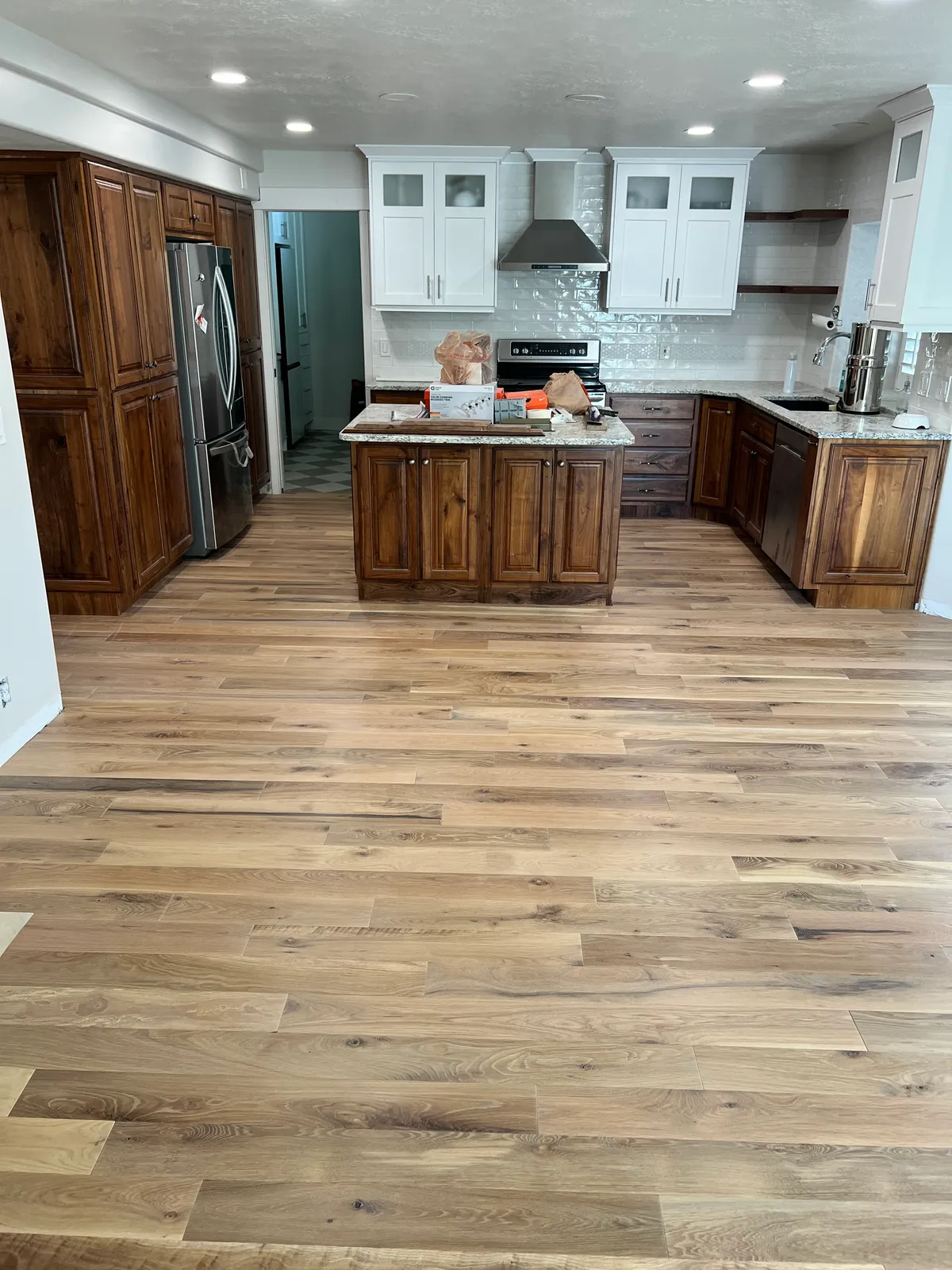
Getting a straight answer on flooring cost is harder than it should be. You search online and find ranges so wide they are basically useless. You call a couple of stores and get quotes that do not include installation. You ask a contractor and get one number with no breakdown.
This guide cuts through that. We will give you realistic installed price ranges for hardwood and waterproof laminate in the Salt Lake City area, walk through what drives the price up or down, and show why the final number should be built line by line around the actual rooms before you commit.
Table of Contents
- What “Installed Price” Actually Means
- Flooring Cost by Category
- What Affects Your Final Price
- Utah-Specific Factors Worth Knowing
- What’s Included in a Plank & Go Quote
- Cost Comparison at a Glance
- So Which Floor Is Right for Your Home?
What “Installed Price” Actually Means
When you see a price per square foot at a big-box store, that is almost always the material cost only. The installed price includes several more line items:
- Materials: the actual flooring product
- Labor: installation by a qualified installer
- Subfloor prep: leveling, patching, or moisture treatment if needed
- Old floor removal: pulling up what is there now
- Underlayment: the layer that sits between the subfloor and the new floor
- Trim and transitions: baseboards, reducers, and doorway pieces
- Furniture moving: some installers include this, many do not, always ask
Throughout this guide, the price ranges we give are installed totals.
Flooring Cost by Category
Hardwood Flooring
Installed price range: $11-$18 per square foot
That range covers solid hardwood. The variables that push you toward the top of the range are wider planks, more complex patterns like herringbone or diagonal, and species such as walnut or white oak versus more common red oak or maple.
For most SLC homes, solid hardwood is a sound investment only if you are putting it on a stable main level and you understand the climate tradeoffs. If you are in a basement or any room that sees moisture fluctuation, solid hardwood is not the right call.
Engineered hardwood installed price range: $11-$18 per square foot
Engineered hardwood has a real wood veneer over a plywood core, which makes it significantly more stable in Utah’s dry climate. It looks like hardwood, installs faster, and handles humidity swings better than solid. Most homeowners in the Wasatch Front are better served by engineered hardwood than solid.
Waterproof Laminate
Waterproof laminate is the practical workhorse of residential flooring. It is durable, water-tolerant, and genuinely strong value when you choose the right product.
Installed price range: $6.50-$10 per square foot
The spread in waterproof laminate pricing largely comes down to core quality and AC rating. Entry-level products may have a lower AC rating, which works in a low-traffic bedroom but will not hold up well in a kitchen or mudroom. We recommend AC4 minimum for main living areas.
Waterproof laminate installs faster than hardwood, which is part of why labor costs tend to be lower. The other advantage is that most waterproof laminate floats over the existing subfloor without glue or nails.
Want to see these options in your home before you commit? Book a free consultation and we will bring the samples to you.
What Affects Your Final Price
Room Size and Layout
Most flooring is priced by the square foot, so a 200 square foot bedroom costs roughly half what a 400 square foot great room does for the same product. What changes the math is irregular room shapes, closets, and multiple doorways, all of which add labor time.
Subfloor Condition
This is the biggest wildcard in any flooring estimate. If your subfloor is flat, clean, and dry, prep is minimal. If it has soft spots, squeaks, height transitions between rooms, or a previous glue-down floor that needs grinding, that adds both labor and sometimes materials. A good installer assesses the subfloor before giving you a final number.
Old Floor Removal
Removing carpet is relatively fast. Removing tile is slow and hard. Glue-down flooring falls somewhere in between. Always ask whether demo is included in your quote and how it is priced.
Pattern Complexity
Standard straight-lay installation is the baseline. Diagonal installation adds roughly 10-15% to labor because of additional cuts and waste. Herringbone or chevron patterns on hardwood can add significantly more.
Trim and Transitions
Every doorway, every stair nose, every meeting point between rooms needs a trim piece. This is often underquoted in big-box estimates because they focus on the floor itself. Expect trim and transitions to add $200-$600 to a typical full-floor project.
Utah-Specific Factors Worth Knowing
Salt Lake City’s environment creates a few flooring considerations you will not find in a generic national guide.
Dry Air and Wood Movement
Salt Lake City averages around 15 inches of precipitation per year, and indoor humidity in winter can drop sharply. This matters for solid hardwood because wood moves with humidity. A solid hardwood floor installed without accounting for acclimation and expansion gaps can cup, warp, or develop gaps over time.
The fix is straightforward: proper acclimation and correct gap spacing at walls. This is standard practice for a careful installer. Engineered hardwood handles Utah’s dry conditions better than solid because of its layered construction.
Basement Considerations in SLC
Most Salt Lake Valley homes have basements, and moisture is the primary concern for any flooring below grade. Even in a dry climate, concrete slabs can transmit moisture vapor. Waterproof laminate is the right answer for most SLC basements because it handles below-grade realities without turning into a fragile maintenance problem.
Altitude and Finish Curing
At Salt Lake City’s elevation, site-finished hardwood can cure a little differently than it does at sea level. This is not a major issue with a knowledgeable installer, but it is worth mentioning if you are considering site-finished hardwood.
What’s Included in a Plank & Go Quote
Here is what our quotes cover during the Free In-Home Floor Fit Consultation:
- In-home consultation: we come to your space, take measurements, and look at the subfloor
- Materials: the flooring product you select from our curated samples
- Underlayment: appropriate to the product and subfloor
- Standard subfloor prep: minor leveling and patching
- Old floor removal: carpet or vinyl
- Installation: by our vetted installers
- Trim and transitions: baseboards and transition strips for the project scope
- Cleanup: haul-away and ready-to-use finish state
What we flag separately before you decide: any subfloor issues discovered during the consultation, tile removal if applicable, and furniture moving if needed beyond standard staging. The goal is simple: you should know what is included, what is not, and what would change the number before you say yes.
Cost Comparison at a Glance
| Category | Installed Price Range | Best For | Not Ideal For |
|---|---|---|---|
| Solid Hardwood | $11-$18/sq ft | Main-level living areas, home resale value | Basements, high-moisture rooms |
| Engineered Hardwood | $11-$18/sq ft | Most rooms including some basements, SLC dry climate | Budget-first projects |
| Waterproof Laminate | $6.50-$10/sq ft | Kitchens, basements, families with kids or pets, bathrooms | N/A, works almost anywhere |
Price ranges reflect installed cost including labor and standard materials for Salt Lake City metro area projects in 2026. Actual quotes depend on room size, subfloor condition, and product selection.
So Which Floor Is Right for Your Home?
If you want the look that adds the most resale value and you are on a main level with stable humidity, engineered hardwood is almost always the right answer for SLC homes. It handles the dry climate better than solid, it looks nearly identical to solid, and it will last for years with basic care.
If you have a basement, a kitchen, kids, or dogs, waterproof laminate is the move. It is tough, budget-friendly, and looks much better than older products in this category.
That is exactly what the in-home consultation is for. We bring a curated selection of samples to your home so you can see each option in your actual lighting, next to your actual furniture, before you make any decision. Then we build the quote line by line so the product choice and the project number are both clear.
Book your Free In-Home Floor Fit Consultation: see the options in your home, get the quote line by line, and move forward without showroom guesswork.