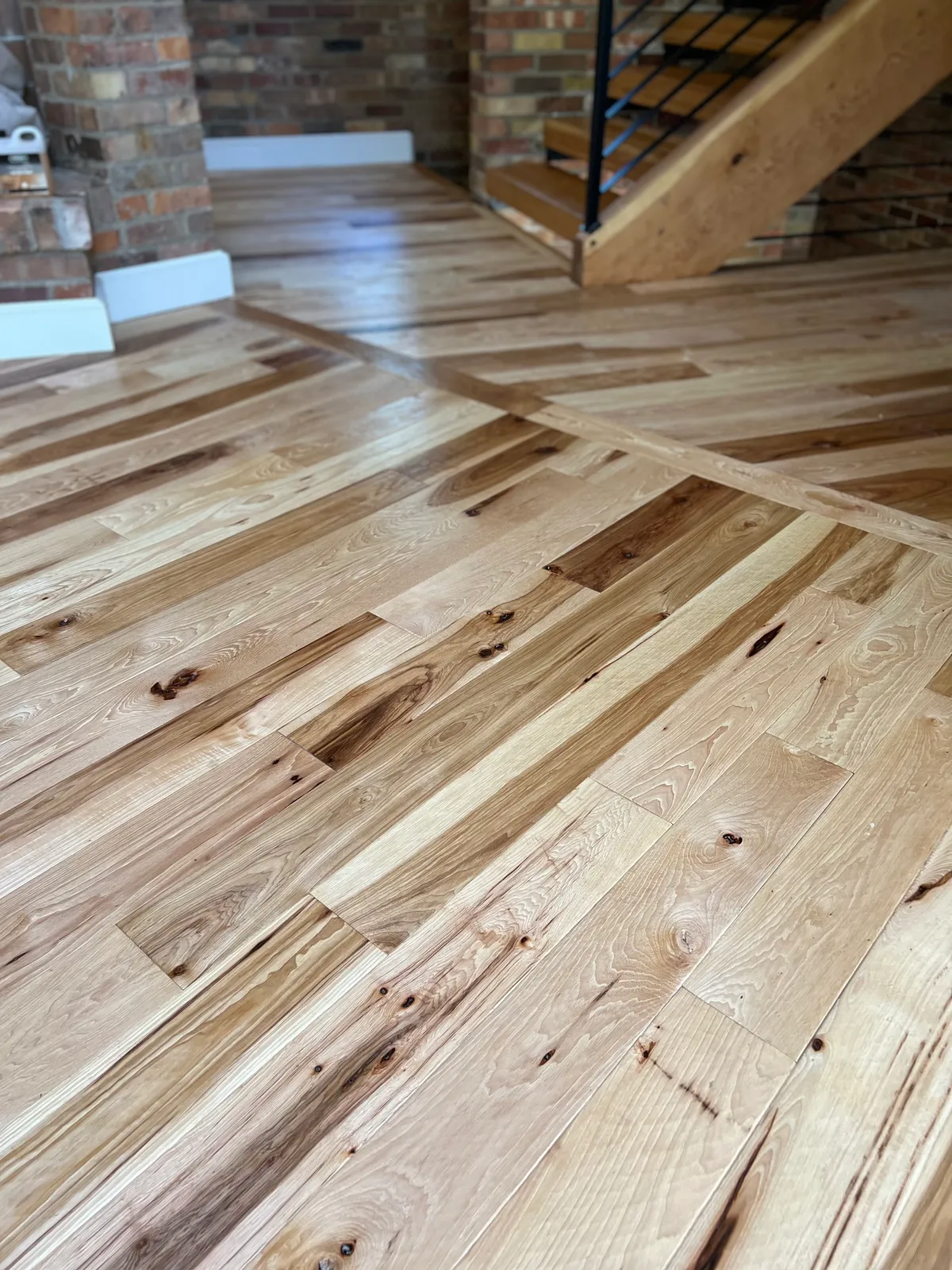
If your hardwood floors are scratched, dull, gapped, stained, or worn through, the right answer is not automatically “refinish” or “replace.” Refinishing is usually the better move when the wood is structurally sound and the damage is mostly in the finish. Replacement is smarter when the floor is too thin, too damaged, poorly laid out, or no longer fits the way the room needs to work.
For Utah homeowners comparing refinishing vs replacing hardwood floors, the best decision usually comes down to three questions: can the existing floor safely be sanded, will repairs make the finished floor look intentional, and does keeping the existing layout still make sense for the home?
For Utah homeowners, the decision also depends on dry air, seasonal movement, older homes, stairs, sunlight, pets, water damage, and whether the existing floor can handle another sanding. This guide will help you sort the obvious cases from the ones that need an in-home look.
Quick answer: should you refinish or replace hardwood floors?
Choose refinishing if the boards are stable, the wear is mostly cosmetic, and you still like the species, width, and layout of the existing floor.
Choose replacement if the floor has widespread water damage, deep stains, loose boards, severe cupping, exposed nails, a thin wear layer, or a layout you do not want to keep.
There is a third path too: repair first, then refinish. That is common when most of the floor is worth saving but a few boards, transitions, or stair pieces need attention before the finish can look right.
Refinishing vs replacing hardwood floors at a glance
| Situation | Better Starting Point | Why |
|---|---|---|
| Dull finish, surface scratches, faded color | Refinish | The floor is usually healthy enough to save. |
| A few damaged boards or bad transitions | Repair, then refinish | Fix the problem areas before the finish coat makes everything visible. |
| Deep water damage, severe cupping, exposed nails | Replace | Sanding cannot solve structural or thickness problems. |
| You want wider planks, a new species, or a different layout | Replace | Refinishing changes color and sheen, not the floor itself. |
| Older Utah hardwood with good material left | Inspect before replacing | Existing hardwood may be worth preserving if it can be safely sanded. |
Refinishing makes sense when the floor is still healthy
Refinishing is the practical choice when the floor itself is good but the top surface looks tired.
That usually means:
- surface scratches from pets, furniture, or daily traffic
- dull finish in walk paths, entries, kitchens, or hallways
- color fade from Utah sun exposure
- minor stains that can be sanded out
- a floor that still feels flat and stable underfoot
- solid hardwood with enough thickness left for another sanding
The benefit is simple: you keep the real wood already in the home and reset the finish, color, and protection. If you like the current plank width and species, refinishing can preserve character that replacement would remove.
This is especially true in older Utah homes where the existing hardwood is part of the house’s value. Tearing it out just because the finish looks worn can be an expensive mistake.
Replacement makes sense when the problem is deeper than the finish
Replacement is the better long-term call when the floor has problems refinishing cannot solve.
Watch for:
- boards that are warped, buckled, or severely cupped
- widespread water damage or dark staining
- movement, squeaks, or loose boards across large areas
- exposed nails or tongues showing through the floor
- engineered hardwood with too little wear layer to sand
- old patchwork that will still look patched after refinishing
- a subfloor issue that needs to be corrected
- a layout, plank width, or species you actively want to change
Refinishing can change color and sheen. It cannot make narrow planks wide. It cannot turn a damaged subfloor into a good one. It cannot make a heavily patched floor look like one clean install.
If the floor has reached that point, replacement may cost more upfront but leave you with a cleaner project and fewer compromises.
Repair first, then refinish is often the overlooked option
Many hardwood floors are not a clean refinish-or-replace decision.
One room may be fine. A hallway may be worn. A kitchen transition may need work. A few boards near a door may have water damage. Stairs may need a different plan than the main floor.
In those cases, the best path can be:
- Replace damaged boards where needed.
- Tighten or address problem areas.
- Sand and refinish the connected floor so the finished result looks intentional.
This is where a line-by-line quote matters. If the bid just says “refinish hardwood floors,” you may not know whether board repair, transitions, stairs, trim, disposal, or furniture moving are included.
Can hardwood floors be refinished more than once?
Solid hardwood can usually be refinished multiple times, but not forever. Every full sanding removes a thin layer of wood. Once the floor gets too thin, sanding becomes risky.
Engineered hardwood depends on the wear layer. Some engineered floors can be lightly refinished. Some cannot be sanded at all. A quick visual check is not enough; the construction of the floor matters.
This is one reason we do not like guessing from a generic cost chart. A floor that looks “bad” may refinish beautifully. A floor that looks decent may not have enough material left to sand safely.
What Utah homes add to the decision
Utah’s dry climate changes how wood floors behave. Seasonal humidity swings can show up as gaps, small cracks, and movement between boards. Mountain homes and ski-area properties may also see harder wear from snow, grit, boots, and moisture near entries.
That does not automatically mean replacement. Some movement is normal. The question is whether the floor is stable and whether the finish plan fits the room.
Common Utah-specific factors include:
- dry air that can make gaps more visible
- intense sunlight that can fade certain stains and finishes
- basement or slab conditions that may favor engineered products or other materials
- entryways that take snow, salt, grit, and water
- stairs that may need repair, replacement parts, or a different finish plan
- older homes where the existing hardwood may be worth preserving
The right floor decision should be made in the room, under the actual lighting, with the real wear patterns visible.
Cost: refinishing is usually cheaper, but not always the better value
Most national cost guides show refinishing as less expensive than full replacement. That is often true because replacement can include demo, disposal, new materials, installation labor, trim, transitions, subfloor prep, and finishing details.
But the cheaper option is not always the better option.
Refinishing may be the better value when:
- most boards are sound
- the floor has enough thickness left
- you like the existing look
- repairs are limited
- the main issue is surface wear
Replacement may be the better value when:
- the repair list is long
- the floor is too thin to sand safely
- the layout or species is not what you want
- moisture or subfloor problems need to be corrected
- you want a different material in part of the home
The quote should make that tradeoff clear. Not one vague number. A line-by-line scope so you can see what you are paying for.
A practical decision framework
Use this before you book anyone:
| What you see | Usually means | Likely path |
|---|---|---|
| Dull finish and surface scratches | Finish wear, not floor failure | Refinish |
| A few damaged boards | Localized issue | Repair, then refinish |
| Deep black stains in many areas | Moisture or pet damage may be deeper | Inspect before deciding |
| Severe cupping or buckling | Movement or moisture problem | Replacement may be needed |
| Exposed nails or very thin boards | Too many previous sandings | Replacement may be safer |
| You want wider planks or a new species | Refinishing cannot change the floor type | Replace |
| Stairs are worn but main floor is good | Mixed-scope project | Separate stair plan plus refinish |
If you are still unsure after this table, that is normal. Floors are physical. The answer depends on thickness, structure, layout, transitions, stairs, and room use.
What we check during an in-home consultation
During a Free In-Home Floor Fit Consultation, the point is not to push one option. The point is to make the decision visible.
We look at:
- whether the floor is solid hardwood, engineered hardwood, or another product
- board condition, thickness, gaps, stains, and movement
- stairs, transitions, entries, kitchens, and high-wear areas
- lighting and stain direction in the actual room
- whether repair work should happen before refinishing
- whether replacement would create a cleaner long-term result
- how the scope should be quoted line by line
You should leave with a clear next step, not a bigger pile of opinions.
FAQ
Is it cheaper to refinish or replace hardwood floors?
Refinishing is usually cheaper when the existing floor is structurally sound. Replacement costs more because it can include tear-out, disposal, materials, installation, subfloor prep, trim, transitions, and other scope items. The right value depends on the condition of your floor.
When should hardwood floors be replaced instead of refinished?
Replacement makes sense when the floor is too thin, deeply water-damaged, severely warped, unstable, heavily patched, or no longer matches the layout or material you want. Refinishing only fixes the surface; it does not solve structural or layout problems.
Can engineered hardwood be refinished?
Sometimes. It depends on the thickness of the wear layer. Some engineered hardwood can handle light refinishing, while thinner products cannot be safely sanded. The product construction needs to be checked before deciding.
Can gaps in hardwood floors be fixed by refinishing?
Refinishing can improve the look of the floor, but it does not automatically fix movement or seasonal gaps. In Utah’s dry climate, some gaps may open and close with humidity changes. Larger or persistent gaps need to be evaluated before choosing a finish plan.
Should I repair damaged boards before refinishing?
Usually, yes. If damaged boards remain in place, the finished floor may still look damaged after sanding and coating. A better plan is often to repair the problem boards first, then refinish the connected floor.
Can Plank & Go help decide between refinishing and replacement?
Yes. That is exactly the type of decision the in-home consultation is built for. We look at the floor in your actual home, explain the tradeoffs, and build a clear quote around the path that fits the room.
Get the floor checked before you spend money on the wrong fix
If you are deciding between refinishing, repair, and replacement, do not make the call from a generic cost range. Let us look at the actual floor, the actual room, and the actual scope.
We will help you see what can be saved, what needs to be fixed, and when replacement is the cleaner answer.
Book your Free In-Home Floor Fit Consultation