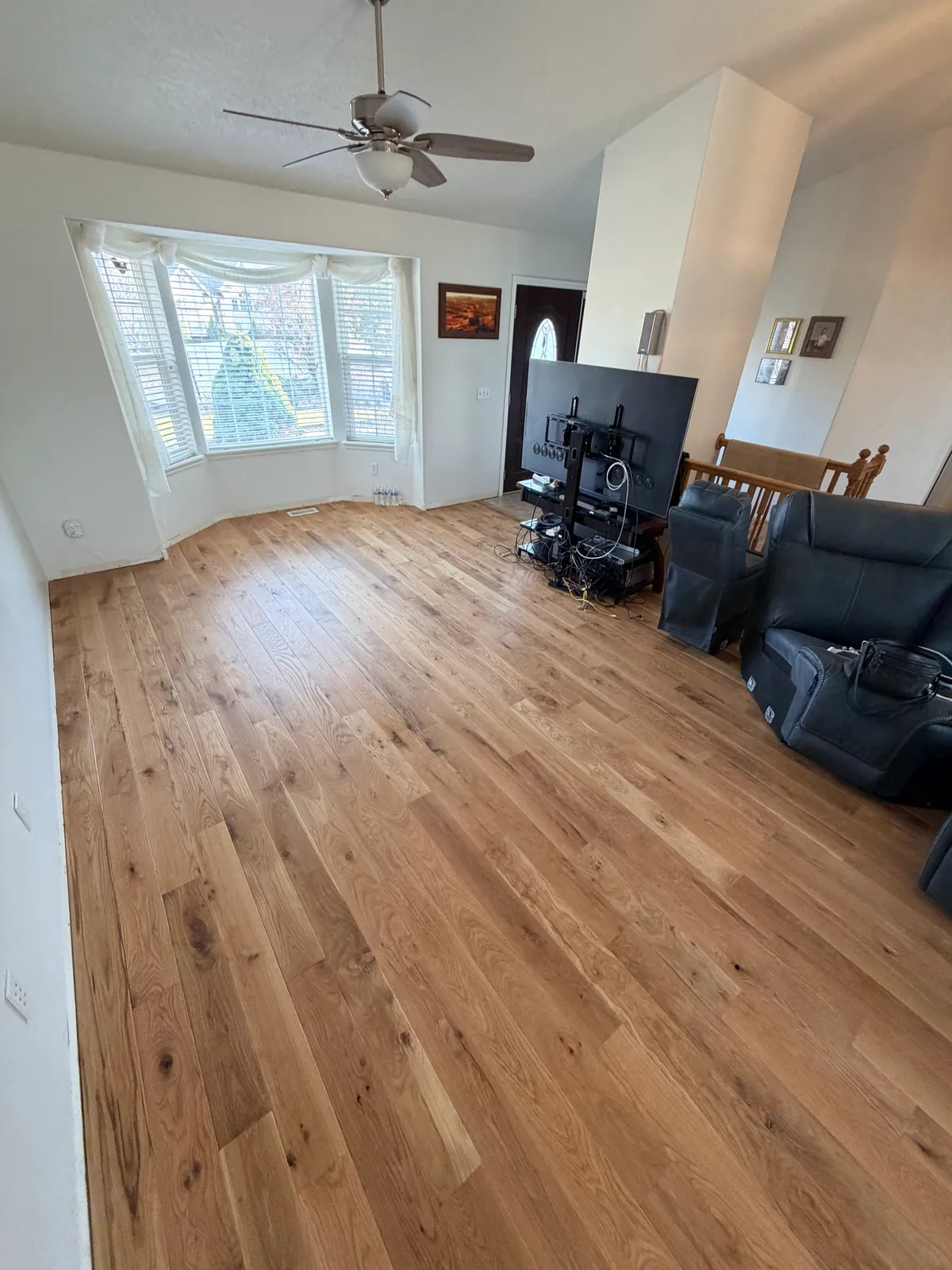
Midvale is in the middle of a transformation. New mixed-use developments and townhome communities are going up while older single-family neighborhoods hold their ground a few blocks away. That mix creates a flooring landscape that’s different from anywhere else in the valley. You’re as likely to be flooring a 900 sq ft condo as you are a 1960s rambler.
This guide covers both sides of Midvale.
Midvale at a Glance
Midvale sits at the crossroads of the Salt Lake Valley. With TRAX running through and its position between Murray and Sandy, it’s become a magnet for development. The population is around 36,000 and climbing as new housing fills in along Fort Union Boulevard and the Bingham Junction area. Neighboring Murray and Sandy share sections of Midvale’s housing profile.
The housing splits into two categories: older single-family homes (1950s-1980s, mostly west of State Street) and newer condos, townhomes, and apartments around the transit corridors. Each has different flooring needs.
Best Flooring Options for Midvale
For Condos and Townhomes: Sound-Rated laminate
If you’re in a condo or townhome, especially a multi-story building. Your flooring choice isn’t just about looks. It’s about sound transmission.
Most HOAs in Midvale’s newer developments require a minimum STC (Sound Transmission Class) and IIC (Impact Insulation Class) rating for any hard-surface flooring installed above the ground floor. The FTC’s consumer guide recommends verifying all HOA requirements in writing before purchasing materials. Typical requirements fall in the STC 50+ and IIC 50+ range, though some buildings require higher.
In practice, you need an SPC-core laminate with an attached acoustic underlayment that meets your building’s requirements. Some buildings require a separate acoustic underlayment beneath the flooring, adding $0.50-1.50/sq ft to your project cost. Always get your HOA’s requirements in writing before buying anything.
We’ve seen homeowners buy flooring, start demo, and then discover their building requires a sound rating they didn’t plan for. Check the HOA rules first.
Installed cost for sound-rated laminate in a Midvale condo: $6-11 per square foot, including the acoustic underlayment.
For Single-Family Homes: laminate or Engineered Hardwood
Midvale’s older single-family homes have the same considerations as most valley communities, aging subfloors, basement moisture, and Utah’s brutal dry climate.
laminate at $5-10/sq ft installed handles all of it. For homeowners who want real wood character, engineered hardwood at $8-14/sq ft installed is a beautiful upgrade for main-level living spaces.
For a detailed comparison, see our hardwood vs. Laminate guide.
For Rental Properties: Durable, Tenant-Proof laminate
Midvale has a strong rental market, and property owners here are sharp about ROI. The right flooring can meaningfully improve tenant retention, people want to live in a place with clean, modern floors. Old carpet is one of the fastest ways to lose a good tenant.
For rental units, we recommend SPC-core laminate with a 20-mil wear layer in a neutral mid-tone. It survives tenant turnover, cleans up fast between leases, and photographs well for listings. Budget $4-7/sq ft installed depending on the product and unit size.
Midvale-Specific Considerations
Small-Space Flooring Strategies
Many of Midvale’s newer condos and townhomes are compact, 800 to 1,200 square feet. Flooring choices can make these spaces feel bigger or smaller, and a few strategies go a long way:
Run one flooring product throughout the entire unit. No transitions between rooms, no material changes from kitchen to living room. This creates visual continuity that makes small spaces feel larger. Laminate is perfect for this because it’s waterproof enough for kitchens and bathrooms, so you don’t need to switch materials.
Go wider. Wide-format planks (7” and up) reduce the number of seam lines, which makes floors look less busy and rooms feel more open. In a 900 sq ft condo, this makes a noticeable difference.
Choose lighter tones. Light oak, natural maple, and blonde wood-looks reflect more light and open up small spaces. Dark floors can feel dramatic in a large room but oppressive in a tight one.
Run planks lengthwise along the longest wall or toward the primary light source. This classic trick draws the eye and elongates the space.
Updating Older Homes Without Overspending
For Midvale’s single-family homes, match your flooring investment to your property values. The smart play is $5-9/sq ft installed: that gets you a quality laminate or entry-level engineered hardwood that looks modern and performs well. See our 2026 cost guide for a full breakdown.
What Midvale Homeowners Are Choosing
The split in Midvale is clear. Condo and townhome owners are choosing sound-rated laminate almost exclusively. It solves the HOA problem, handles small spaces well, and the waterproof factor means one product works everywhere.
Single-family homeowners are split between laminate and engineered hardwood, usually based on budget. Rental property owners are all in on laminate: the math just works for reduced maintenance and faster unit turns.
If you’re curious about the latest looks, our 2026 flooring trends guide covers what’s popular across the Wasatch Front. One trend specific to Midvale: homeowners are matching their flooring to the modern, minimal aesthetic of newer construction nearby. Clean lines, light colors, wide planks. Even in older homes, this approach brings the space into 2026 without a full remodel.
Ready to See Your Options in Your Space?
We’ll bring curated flooring samples to your Midvale home or condo, including sound-rated options for HOA-governed buildings. See everything in your actual space with your actual lighting. No showroom trip, no guessing.