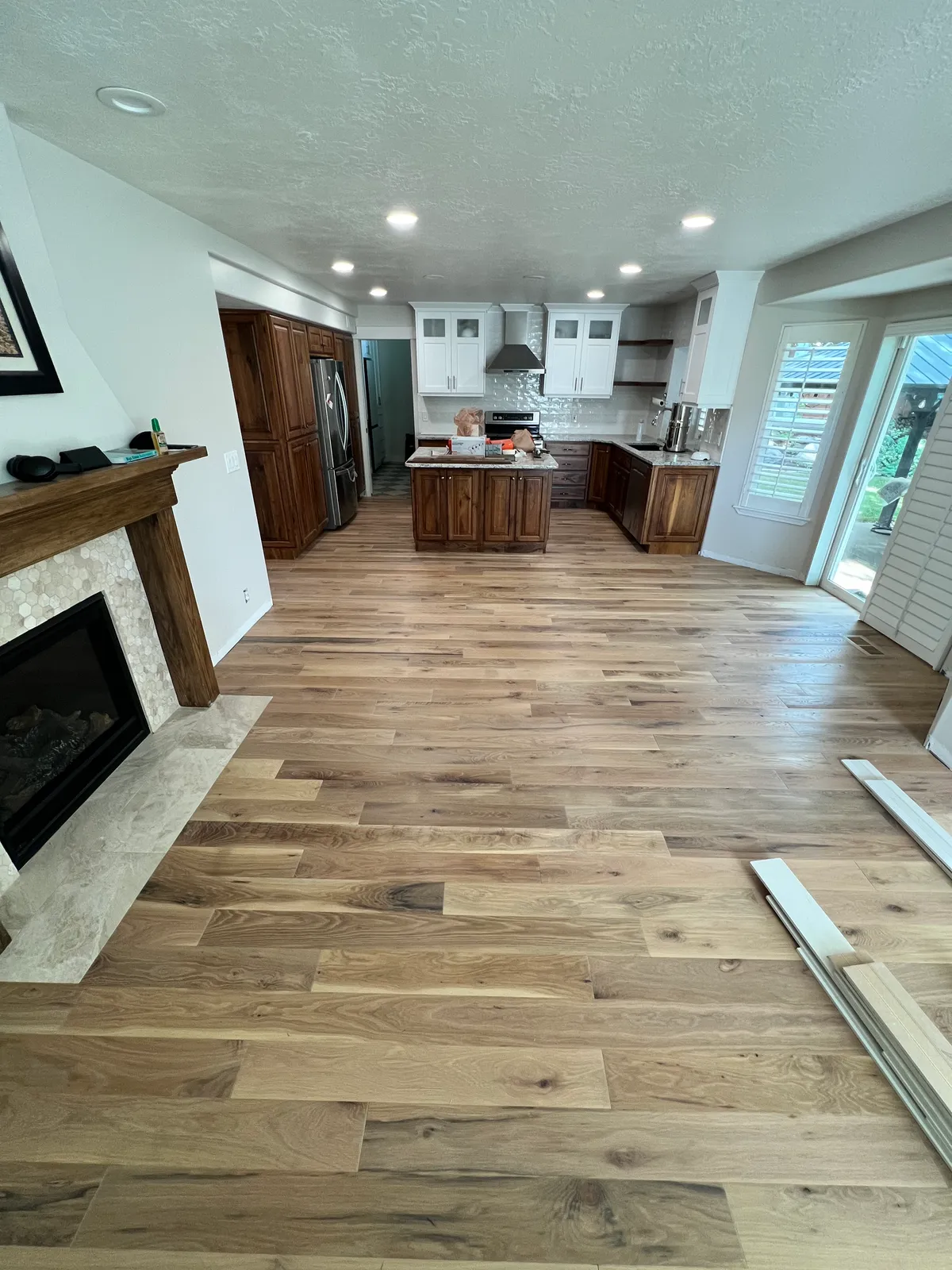
West Jordan is one of Utah’s fastest-growing cities, and the housing stock reflects it, neighborhoods built across three decades of suburban development, from early 90s subdivisions to homes that are barely ten years old. The flooring challenges here are different from SLC’s historic neighborhoods. You’re not matching century-old trim. You’re updating 90s carpet, finishing basements, and making open floor plans look cohesive.
This guide covers what works best for West Jordan’s homes and the families living in them.
West Jordan at a Glance
Population around 116,500, with steady growth over the past two decades. The city sits on the southwest side of the Salt Lake Valley, between South Jordan and Taylorsville, at roughly 4,400 feet of elevation. Same dry Utah air, same dramatic seasonal humidity swings as the rest of the valley.
The housing stock is predominantly 1990s through 2010s construction. That means you’ll see a lot of:
- Two-story homes with open main-level floor plans
- Ramblers and split-entries from the 90s
- Newer two-story and multi-level builds from 2005–2020
- Finished and unfinished basements in nearly every home
Most of these homes were built with carpet throughout, builder-grade tile in kitchens and baths, and sometimes basic sheet vinyl. After 15-25 years, those original materials are ready for an upgrade.
Best Flooring Options for West Jordan
Laminate: The Family Floor
For West Jordan’s mix of young families, active households, and homes with basements, laminate with an SPC core is the clear front-runner.
The case is straightforward: it’s waterproof, scratch-resistant, comfortable underfoot, and priced right for the scale of most West Jordan flooring projects. When you’re covering 1,500+ square feet of main level plus a basement, the per-square-foot cost matters, and laminate delivers serious quality in the $5–$7 range.
What makes it particularly right for West Jordan homes: these are family houses. Sippy cups get knocked over. Dogs come in from the backyard. Kids drop things. Snow and mud get tracked through the front door six months a year. Laminate takes all of it without complaint.
Installed cost: $6.50–$10 per square foot.
Engineered Hardwood: The Premium Main-Level Choice
If you want the look of real wood on your main level, engineered hardwood is the right version for our climate. It’s especially popular in West Jordan’s newer builds where the open floor plan makes the main level feel like one continuous space, a beautiful engineered hardwood tying that whole space together makes a statement.
Pair it with laminate in matching tones for the basement and wet areas, and you get a cohesive look throughout the house without overspending.
Installed cost: $11–$18 per square foot.
For a deeper look at how these materials perform in Utah, read our guide to the best flooring for Utah’s dry climate.
West Jordan-Specific Considerations
Updating 90s Carpet and Tile
If your home was built in the 90s, you’re probably living with the original flooring. Here’s what we typically find:
Carpet everywhere. After 25+ years it’s matted, stained at the seams, and holding allergens no amount of cleaning can fix. Ripping it out for hard surface is the single biggest visual upgrade you can make.
Builder-grade 12x12 tile in kitchens and entryways. Dated but usually structurally fine. You can float laminate directly over flat tile (cheaper) or remove and start fresh (cleaner transitions). We’ll help you weigh the trade-offs.
Sheet vinyl in bathrooms. Yellowed, peeling at the edges. Swapping it for laminate or new tile is a quick, high-impact upgrade.
Flooring for Open Floor Plans
West Jordan’s newer homes (2000s–2010s) typically have open floor plans where kitchen, dining, and living room are one space. This demands continuity, different materials in each zone looks choppy. One material, one color through the entire open area. Laminate handles this perfectly because it works in the kitchen (waterproof) and living area (durable) without transitions.
Basement Finishing
Nearly every West Jordan home has a basement, and many are unfinished or partially finished. Laminate over concrete is the standard, waterproof, floats over the slab with proper underlayment, handles the cooler temperatures basements run.
Always moisture-test the slab first. Even in Utah’s dry climate, concrete can transmit moisture vapor. If levels are elevated, a vapor barrier underlayment solves it. Choose laminate with attached padding for extra warmth and cushion. It makes the space feel like a living area, not a basement.
For the full breakdown, see our guide to the best flooring for Utah basements.
Growing Families, Changing Needs
Your flooring needs to grow with your family. Toddler years demand waterproof and easy-clean, crayon on laminate wipes off, crayon on carpet does not. School age brings sports gear, more friends, more traffic, a 20-mil wear layer handles the activity. And the floors you install when the kids are small should still look good when they’re in high school.
Buy once, buy right. Spending an extra dollar per square foot on a better wear layer saves you a full reinstall in eight years.
What West Jordan Homeowners Are Choosing
Here’s what we’re seeing across West Jordan in 2026:
Whole-house laminate is the most common project. Main level, hallways, sometimes bedrooms, one product, one color, everywhere. It simplifies the decision, looks great, and maximizes the budget.
Basement finishing with laminate is a close second. Families are converting unfinished basements into playrooms, home offices, media rooms, and guest suites. Laminate is the default flooring for all of these.
Light-to-mid-tone wood looks dominate color choices. Natural oak, light walnut, and greige tones are the most popular. They brighten up the space (basements especially benefit from lighter tones), work with most paint colors, and don’t show every speck of dust.
Stair conversions are picking up. Matching new flooring up the stairs and through the upper hallway ties the whole home together. More labor-intensive, but a dramatic visual improvement. The NWFA provides installation guidelines for stair nosing and transitions.
For detailed pricing information, see our 2026 flooring cost guide.
Ready to See What Works in Your Home?
We bring curated samples directly to your door. No showroom trip, no pressure. You see everything in your actual lighting and next to your actual walls before you decide anything.